
Marion Epoxy Flooring installs basement floor epoxy in Marion, IA, serving surrounding cities including Hiawatha, Cedar Rapids, Mount Vernon, Stone City and Anamosa. In 20+ years of coating concrete we have learned that the coating is the easy part of a basement floor. The hard part is knowing what the slab is doing underneath it, so every basement job we take starts with reading the floor for past water, checking the sump pit and floor drain, and testing the concrete before we recommend anything.
A basement slab lives in different conditions from a garage floor. It sits below grade, it is surrounded by soil that can hold water against it, and it is often tied into drain tile and a sump. A coating that goes down over a slab pushing up moisture will blister or lift no matter how carefully it was rolled.
Done right, a coated basement floor is bright, easy to clean and tough enough for laundry rooms, workshops, home gyms and storage. This page explains what we check, what we will and will not promise, and how we build a basement floor that stays bonded.
Reading the Basement Before We Quote
Signs of Past Water
We look for tide lines on the walls, rust at the base of steel posts, staining around the floor drain, lifted tile and white crust on the concrete. Each one tells us something about when and where water has come in, and whether it came from the walls, the floor or a backup.
We also ask about the house: how long you have owned it, whether the sump runs often, and whether the basement has ever taken water in a heavy storm. Those answers shape the test plan and the system we recommend.
Efflorescence and What It Means
A white, powdery or crusty deposit on a basement floor is efflorescence. It forms when moisture moving through the concrete carries dissolved salts to the surface and leaves them behind as it evaporates.
Efflorescence is not the problem itself, but it is proof that water is traveling through the slab. Grinding it off and coating over it without testing is how basement coatings fail, so we treat it as a reason to measure before we go any further.
Moisture Testing the Slab
The ASTM D4263 plastic sheet test is a simple first screen: a taped-down sheet that shows condensation or darkening if moisture is coming up. When we need numbers, ASTM F1869 calcium chloride kits measure vapor emission at the surface and ASTM F2170 probes measure relative humidity inside the slab.
The result is written into your scope before the price is final. It decides whether a standard primer will do, whether a moisture-mitigation primer is needed, or whether the floor should not be coated until the water source is dealt with.
Sump Pits, Drain Tile and Floor Drains
How Marion Basements Are Drained
Marion Code section 126-37 has a house’s floor-base and perimeter drains run to an interior sump that is piped to the storm sewer, with a pump required when water in the pit will not fall well below the lowest basement floor. In practice, most basements here have drain tile and a sump pit working under or beside the slab.
That system is what keeps groundwater away from the floor. A coating sits on top of it and should never interfere with it, so we check the pit, the pump discharge and any floor drain before work begins.
Finishing Around the Pit and Drains
We coat up to the sump pit and floor drains with clean edges, leaving lids, grates and cleanouts fully accessible. Coating over a drain or gluing a pit lid down turns a routine pump service into a repair job.
Grinding dust is captured at the machine with a vacuum rather than rinsed toward a floor drain or into the pit, because that slurry ends up in the same line that carries the basement’s groundwater away.
Backups and Backwater Valves
Some basements take water from a sewer backup rather than from the ground. Marion can require backwater valves where the City Engineer decides they are needed, and if your floor drain has backed up before, that is worth raising with a plumber before the floor is finished.
A coated floor makes cleanup after a backup much easier, but it does not prevent one. We will tell you what we see and point you to the right trade.
Building the Basement Floor System
Removing Paint, Patching and Mastic
Older basements often carry several layers of floor paint, patching compound and black tile mastic. We grind those off with diamond tooling instead of coating over them, because the new floor can only bond as well as the weakest layer below it.
Some older mastics need careful handling, so we identify what is on the floor at the estimate and plan the removal method before the crew arrives.
Moisture-Mitigation Primers
When testing shows vapor emission or relative humidity above what a standard epoxy primer tolerates, a moisture-mitigation primer goes down first. It is built to resist vapor pressure from below and gives the rest of the system a stable base.
It adds cost, so we do not specify it by habit. It goes into the proposal only when the ASTM F1869 or ASTM F2170 numbers show it is needed, and the proposal says which reading drove the decision.
Base, Broadcast and Topcoat
Above the primer, a 100% solids epoxy base builds thickness, and a flake or quartz broadcast adds texture and color. A clear topcoat seals the surface, and its texture is set for the room, with more grip near the washer and the stairs.
The proposal names the product line, the number of coats and the finished thickness, so you can check the floor against the quote.
Low-Odor Systems for Living Spaces
Because a basement shares air with the house, we offer low-odor coatings and ventilate during the work. That is a comfort and re-entry choice for your household, not a legal requirement in Iowa, which follows the federal VOC limits for floor coatings.
What a Coating Can and Cannot Do
Not Waterproofing, Not Radon Work
A floor coating is never sold here as basement waterproofing or radon mitigation, and we say that in writing. Water is managed by grading, drain tile and the sump; radon is managed by a credentialed mitigator under Iowa Code chapter 136B.
Marion adopted the radon-resistant construction appendix for new homes, which shows how seriously the city treats the gas. We recommend testing for radon before finishing a basement and dealing with any result first.
Basements Near Indian Creek
Nearly all of Marion sits in the Indian Creek watershed, and the June 2002 Indian Creek flood is still the benchmark many local homeowners remember. If your basement has flooded before, a coated floor is a practical choice because it cleans up far faster than carpet or bare concrete.
What it will not do is keep floodwater out. After any water event, the floor has to be cleaned, dried and retested before it is coated or recoated.
Warranty Exclusions, Explained Up Front
Nearly every basement coating warranty excludes moisture vapor transmission and hydrostatic pressure from below the slab, and those are the most likely reasons a basement floor would fail. We name those exclusions before you sign.
New structural cracks, impact damage and chemicals the floor was not specified for are usually excluded too. Knowing that in advance is part of making a sound decision about your floor.
Good Uses for a Coated Basement
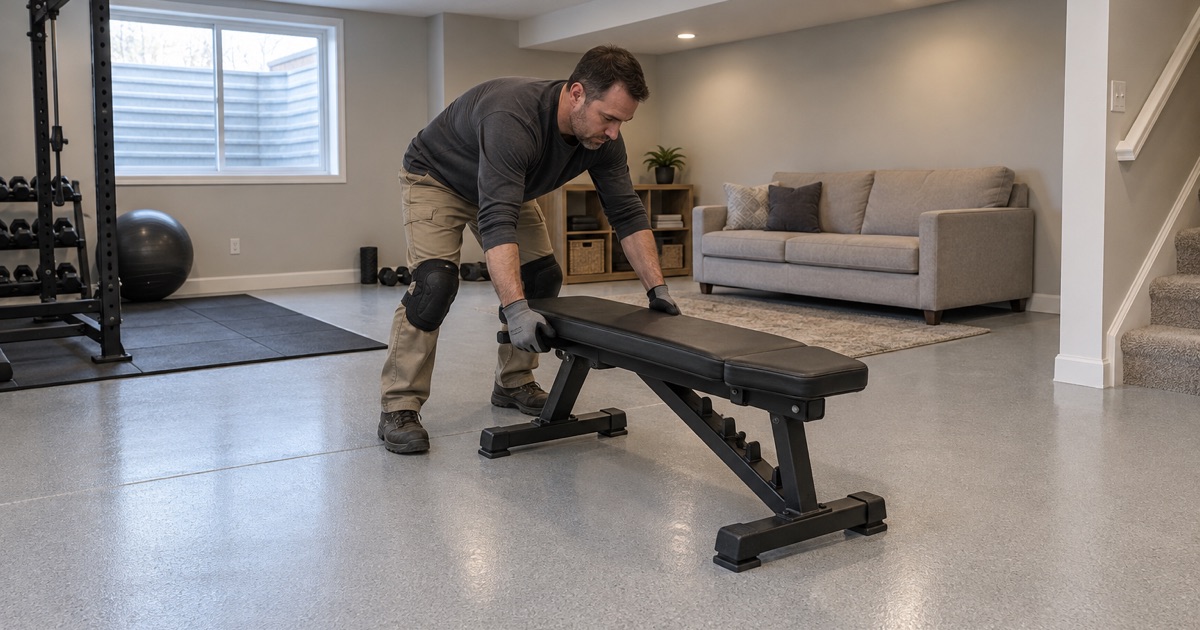
Laundry rooms benefit from a floor that shrugs off detergent and water spills. Workshops get a surface that takes dropped tools and sweeps clean, and home gyms get a durable base under racks and mats.
Storage areas gain a bright floor that does not shed concrete dust onto boxes, and family rooms can pair a decorative flake or metallic finish with area rugs for a finished look without carpet.
- 20+ Years on Concrete
- Moisture Tested Before Pricing
- Free Written Estimates