
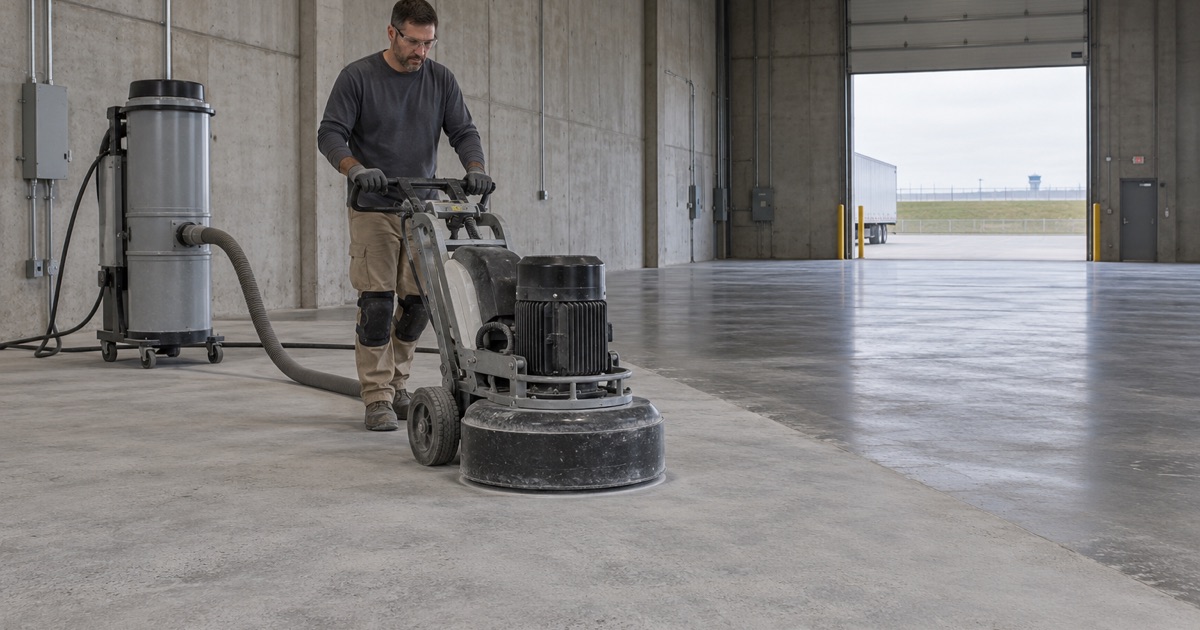
Marion Epoxy Flooring provides concrete grinding in Marion, IA, serving surrounding cities including Hiawatha, Cedar Rapids, Mount Vernon, Stone City and Anamosa. After 20+ years of coating floors we treat grinding as the step that decides whether everything after it lasts, so we use diamond grinders and shot blasters sized to the job and connect every one of them to dust collection at the machine.
Grinding removes what a new floor cannot bond to: old paint and epoxy, sealers, curing compounds, carpet glue, tile mastic, oil-soaked concrete and the weak cement paste that sits on top of most slabs. What it leaves behind is a clean, open surface with a measured texture that a primer, coating, overlay or adhesive can grip mechanically, rather than just sitting on top.
We grind slabs for our own coating and polishing work, and we also prepare floors for owners and installers who need old coverings removed or a slab flattened before tile, vinyl or wood goes down. The right equipment and profile depend on what comes next, so we always start by asking what the floor is being prepared for.
Surface Profiles and Why They Matter
ICRI Concrete Surface Profiles
The International Concrete Repair Institute publishes a scale of concrete surface profiles from CSP 1, nearly smooth, to CSP 10, very rough. Coating and overlay manufacturers state which profile their products need, and thin coatings generally want a lighter profile than thick mortars or overlays.
We match the grind to the product going on the floor. Too smooth and the coating has little to grip, while too rough and a thin coating will show every scratch and use far more material to fill the texture.
Why Acid Etching Falls Short
Acid etching is often sold as preparation for garage floor kits because it needs no equipment. It only reacts with clean, bare concrete, so it does nothing to sealers, oil stains or curing compounds, and it leaves an uneven, shallow profile with residue that has to be rinsed thoroughly.
That rinse water and acid usually end up in a floor drain, a sump or the driveway. Mechanical grinding with vacuum collection avoids both the weak bond and the runoff, which is why we never etch a slab we intend to coat.
Grinding Equipment for Each Job
Diamond Grinders
Planetary diamond grinders are our main tool for garages, basements and most commercial interiors. Different diamond bonds and grits let us strip coatings aggressively, open a profile for a coating, or step down progressively for polishing on the same machine.
Edge grinders handle the strip along walls, around columns and into corners that a large machine cannot reach. Leaving that perimeter unground is one of the most common reasons a coating starts peeling at the walls first.
Shot Blasting
Shot blasters propel steel shot at the slab and recycle it through the machine, leaving a uniform profile across large open floors quickly. They are efficient on warehouses, plants and parking areas where a coarser profile suits a thicker system.
Shot blasting does not flatten a floor or remove thick, gummy coatings well, so on many commercial jobs we use both machines: grinders for removal and flattening, the blaster for an even final profile.
Dust Captured at the Machine
Every grinder and blaster we run is connected to an industrial vacuum with filtration sized to the dust it produces. Capturing dust at the source protects the crew, the building and the people in it, and it keeps fine concrete powder out of mechanical systems and stored goods.
We never wash grinding slurry toward a floor drain, a sump pit or a storm inlet. In Marion, basement sumps discharge to the storm sewer, so anything rinsed into one leaves the property.
What We Grind Off
Old Coatings and Sealers
Peeling epoxy, failed garage kits, floor paint and acrylic sealers all come off with aggressive diamond tooling. Coating over a failing layer only bonds the new floor to something that is already letting go, so we remove old coatings completely rather than scuffing them.
Well-bonded industrial coatings are sometimes left and abraded for recoating, but only after we test adhesion across the floor. If any part of the old system is lifting, it all comes up.
Adhesives, Thinset and Mastic
Carpet glue, vinyl adhesive, thinset and tile mastic are common in basements and older commercial buildings. Each takes different tooling, and soft, gummy glues are slower to remove because they clog the diamonds.
Some older black mastics need careful handling, so we identify what is on the floor at the estimate and plan removal before the crew arrives.
Weak Paste and Contamination
Most slabs carry a thin layer of weak cement paste, called laitance, on top. Grinding removes it along with oil and grease that have soaked into shop and garage floors, exposing sound concrete underneath.
Deeply soaked oil may need degreasing and a second pass. We would rather spend that time than have a coating lift off an old drip spot within a year.
Flattening and Repairs
Lips, Ridges and High Spots
Grinding takes down lips where a slab has cracked and shifted, ridges along joints and high spots left by the original finisher. That alone can make a floor safer to walk and easier to coat evenly.
For low areas, grinding is paired with patching or a self-leveling underlayment, because a grinder can only remove concrete, never add it.
Preparing Cracks and Joints
Cracks and control joints are cut open and cleaned during grinding so repair material can bond to sound concrete at the edges. Repairs are then ground flush, so they do not telegraph through a thin coating.
Where a slab has heaved or crumbled across large areas, grinding is not enough, and we will tell you the floor needs concrete repair or replacement first.
- 20+ Years on Concrete
- Moisture Tested Before Pricing
- Free Written Estimates