
Marion Epoxy Flooring installs ESD flooring in Marion, IA, serving surrounding cities including Hiawatha, Cedar Rapids, Mount Vernon, Stone City and Anamosa. Over 20+ years of commercial and industrial floor work, we have learned that an ESD floor is a measured system, not a color or a product name, so we install to the resistance range your program calls for and test the finished floor before handing it over.
Electrostatic discharge, or ESD, is the sudden release of static charge built up on people, carts and materials. A discharge too small for a person to feel can still damage sensitive electronic components, corrupt data or, in some environments, ignite flammable vapors. A static-control floor gives that charge a controlled path to ground.
The Cedar Rapids and Marion area is home to electronics, avionics and precision manufacturers, along with labs, data rooms and medical spaces that care about static. Each one has its own specification, so we start with yours and build the floor to meet it rather than guessing at a generic range.
How ESD Floors Work
Conductive and Static-Dissipative Ranges
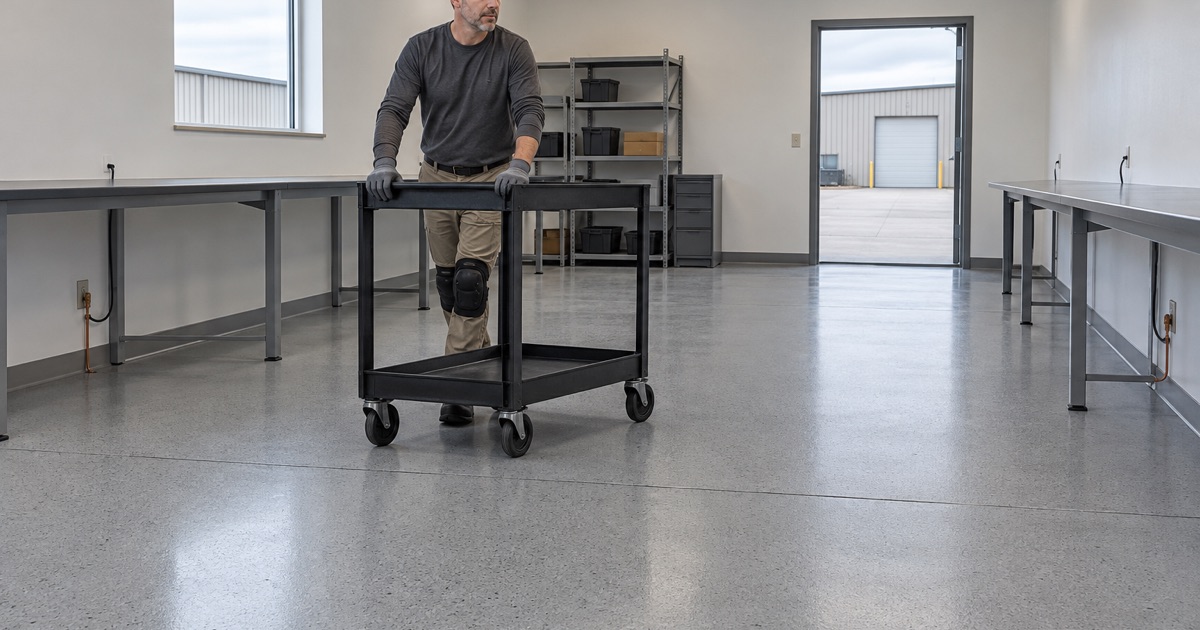
ESD floors fall into two broad groups. Conductive floors have the lowest electrical resistance and move charge to ground quickly, while static-dissipative floors sit in a higher range and drain charge more gradually.
Which range you need depends on the components handled, the equipment in the room and your quality program, often written around the ANSI/ESD S20.20 standard. We take the required range from your specification and confirm it with you before we order materials.
Grounding the Floor
An ESD coating only works if it is connected to ground. Copper grounding strips or tabs are laid on the primed slab, connected to the building’s ground at set points and covered by the conductive layers of the system.
We agree the ground point locations with your electrician or facility team before installation. A floor that tests well in the middle but is poorly grounded at the edges will not protect anyone.
Floor and Footwear as One System
An ESD floor carries charge away from people only when their footwear lets it. Heel grounders, ESD shoes or conductive soles complete the path, while ordinary rubber soles insulate the wearer from the floor.
Most static control programs test the person, footwear and floor together. We can help you understand how the floor contributes, but the footwear policy and entry testing are part of your program.
Installing an ESD Floor System
Grinding and Slab Preparation
Every ESD floor starts with a diamond-ground slab, never an acid etch. Old coatings, adhesives and contamination come off completely, because the system needs a strong bond and a continuous conductive layer.
Cracks and joints are repaired and ground flush. The slab is tested for moisture as part of the written scope before pricing, since vapor drive can lift an ESD system just as it lifts any other coating.
Conductive Primer and Body Coat
After grinding, a conductive primer goes down with the grounding strips, followed by a body coat formulated with conductive fillers. Each layer has to be applied evenly, because thin or thick spots change the resistance across the floor.
Slab temperature and dew point are measured before each coat. Condensation or amine blush between layers can interrupt the conductive path, and that is very hard to fix once the topcoat is on.
Resistance Testing Before Handover
Once the system cures, we test resistance point to point and point to ground at locations across the floor using the method your specification names. The readings are recorded and handed to you as part of the job file.
Any area that reads outside the required range is corrected before the floor is handed over, not left for your quality team to discover at the first audit.
Where ESD Flooring Is Used
Electronics Assembly and Test Areas
Electronics assembly, repair and test areas are the classic use. Circuit boards, components and modules can be damaged by discharges well below what a person can feel, and that damage may not show up until a product fails in service.
These areas also need clean, light-colored floors where dropped components can be found. We specify colors and finishes with that in mind.
Server Rooms and Control Rooms
Server rooms, network closets and control rooms use static-control floors to protect equipment and reduce nuisance faults. Raised floors are common here, but slab-on-grade rooms often take an ESD coating directly on the concrete.
We coordinate with IT and facilities staff so the work happens during a planned window and dust is captured at the machine, away from running equipment.
Labs, Medical and Hazardous Areas
Some laboratories, medical imaging rooms and areas handling flammable materials need static control for safety as well as equipment protection. Their specifications can be stricter and may call for a conductive rather than a dissipative range.
We work from the engineer’s or owner’s specification in these spaces and do not substitute products without approval.
Caring for an ESD Floor
Cleaning That Protects Resistance
Floor finishes, waxes and some cleaners leave an insulating film that pushes resistance out of range. We hand over cleaning instructions that name compatible products and methods, and we recommend sharing them with every cleaning contractor who touches the floor.
Auto-scrubbers with neutral cleaners are usually fine. What causes trouble is a well-meaning crew applying a polish to make the floor shine.
Periodic Testing and Recoats
Most ESD programs include periodic floor testing. If readings drift as the topcoat wears in heavy traffic lanes, those areas can be abraded and recoated with a compatible conductive topcoat and retested.
Keeping records of the original readings makes it easy to see when and where the floor is changing, which is why we leave them with you at handover.
- 20+ Years on Concrete
- Moisture Tested Before Pricing
- Free Written Estimates