
Marion Epoxy Flooring handles concrete floor repair in Marion, IA, serving surrounding cities including Hiawatha, Cedar Rapids, Mount Vernon, Stone City and Anamosa. In more than 20 years of preparing slabs for coatings, we have repaired cracks, spalled edges and salt-damaged surfaces in garages, basements and shops of every age, and we have also learned to say plainly when a floor needs more than a patch.
Every slab we coat or polish is mapped first, with cracks, spalls, pitted areas, broken joint edges and old coatings marked and written into the scope. That map tells you what will be fixed and how, and it keeps a repair from becoming a surprise charge halfway through the job.
Concrete floor repair can stand alone on a shop or warehouse floor where broken joints are wrecking cart wheels, or it can be the first stage of a garage, basement or commercial coating. Either way, the repair has to bond to sound concrete and finish flush, or it becomes the weak spot in the floor.
Crack Repair in Concrete Slabs
Hairline and Shrinkage Cracks
Almost every slab develops fine shrinkage cracks as it cures, and they are usually cosmetic. On a coated floor they still matter, because an unfilled crack can telegraph through a thin coating and collect dirt along its line.
We open hairline cracks slightly with a grinder or crack chaser, vacuum them clean and fill them with a repair material that bonds to the edges. Once ground flush, they are invisible under a broadcast coating and read as faint lines under a clear or polished finish.
Wider and Moving Cracks
Wider cracks, especially those with one side higher than the other, tell us the slab has moved. We check whether the movement is old and stable or ongoing, because a rigid filler in a moving crack will simply crack again beside the patch.
Stable cracks get a rigid, structural-grade filler. Cracks that will keep moving with seasonal changes get a flexible filler, or are honored through the coating as a joint so the floor can move without tearing the finish.
Control Joints
Control joints are sawn or tooled into a slab so it cracks in straight lines where it is designed to. Filling them rigidly can force the next crack to appear somewhere less tidy, so we usually fill them with a semi-rigid or flexible material.
On warehouse and plant floors, joint edges take a beating from forklift and pallet jack wheels. Rebuilding broken edges and filling the joint flush stops that damage from spreading and makes the floor quieter and smoother to drive.
Spalls, Pitting and Salt Scaling
Spalled Edges and Chips
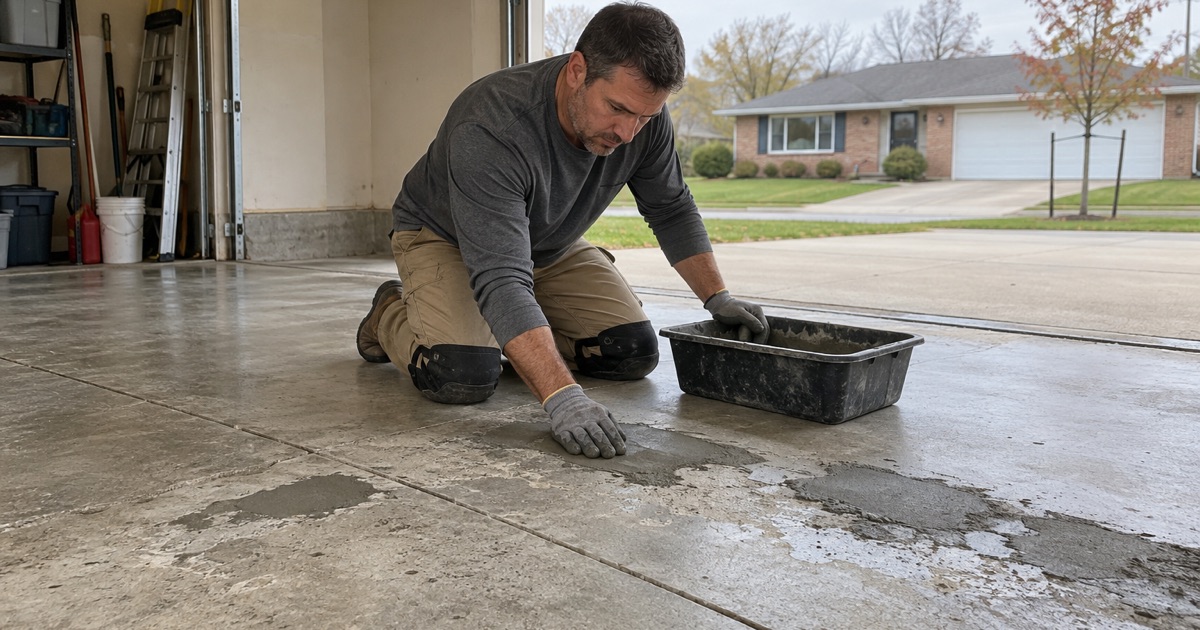
Spalls are pieces of concrete that have broken away, usually at joints, crack edges or where something heavy was dropped. We cut back to sound concrete, clean the area and rebuild it with a repair mortar or epoxy patch that bonds to the base.
The repair is then ground flush with the surrounding slab. A spall left proud or low shows clearly through a coating and catches wheels and toes alike.
Salt Scaling on Garage Slabs
Scaling is the flaking or peeling of the top layer of concrete, and in eastern Iowa it is most common in garages and along aprons. Brine and rock salt ride in on vehicles from November through March, soak into the slab and freeze and thaw repeatedly, which breaks the surface apart.
We grind scaled areas back to sound concrete and resurface them before coating. The sealed coating then keeps salty meltwater on top of the floor, which is the most reliable way to stop scaling from returning.
Pitting and Popouts
Small pits and popouts appear when weak aggregate or trapped air near the surface breaks away. They are usually cosmetic but collect dirt and moisture, and they show through thinner coatings.
We fill pits during the skim stage after grinding, so the coating goes down over a uniform surface. On a polished floor, they may be filled with a color-matched material or left as part of the slab’s character.
When Repair Is Not Enough
Heaving, Settling and Broken Slabs
A slab that has heaved, settled away from a wall or broken into separate pieces has a soil or drainage problem underneath. Patching the surface will not fix that, and a coating over it will crack along the same lines.
We tell you plainly when a slab needs to be lifted, repaired structurally or replaced before it should be coated. Replacing a section first is often cheaper than coating twice.
Moisture Behind the Damage
Some damage is caused by water moving through the slab, such as efflorescence, crumbling near a basement wall or patches that keep failing. We test the concrete for moisture as part of the written scope before we price a repair and coating.
If water is the cause, the fix has to address drainage or vapor first. A coating does not stop seepage, and we will not sell one as if it did.
Old Patches and Failed Repairs
Many floors carry patches from earlier repairs that have cracked, debonded or turned powdery. We sound them out, remove anything that is not firmly bonded and repair again with materials compatible with the coating that will follow.
A floor is only as sound as its weakest patch, so we do not coat over repairs we cannot vouch for.
Freeze-Thaw and Frost Movement
Marion builds foundations to a 42-inch frost line for a reason: ground that freezes deep moves. Detached garage slabs and aprons sitting on frost-susceptible soil can lift in winter and settle in spring, and the cracks they develop open and close with the seasons.
Those cracks need flexible repairs and honest expectations. We can make them clean and sealed, but no surface repair stops a slab that rides up and down on frozen ground every year.
- 20+ Years on Concrete
- Moisture Tested Before Pricing
- Free Written Estimates