
Marion Epoxy Flooring installs flake epoxy floor systems in Marion, IA, serving surrounding cities including Hiawatha, Cedar Rapids, Mount Vernon, Stone City and Anamosa. Flake floors are the system we are asked about most often for garages, and after 20+ years of installing them we know that their good looks are the least of what makes them last: the grind under the base coat, the moisture test before pricing and the topcoat on top all matter more than the color of the chips.
A flake floor is a layered system. A base coat goes down on a prepared slab, colored vinyl flakes are broadcast into it while it is wet, the excess is scraped and vacuumed away after it cures, and a clear topcoat locks the flakes in. The flakes add color and texture, hide small imperfections in the concrete and give the floor its familiar speckled, granite-like look.
The system works in garages, basements, laundry rooms, workshops, locker rooms and many commercial spaces. This page explains how we choose blends and chip sizes, how we build the system underneath and what keeps a flake floor looking good through years of Iowa winters.
Choosing Flake Blends and Chip Sizes
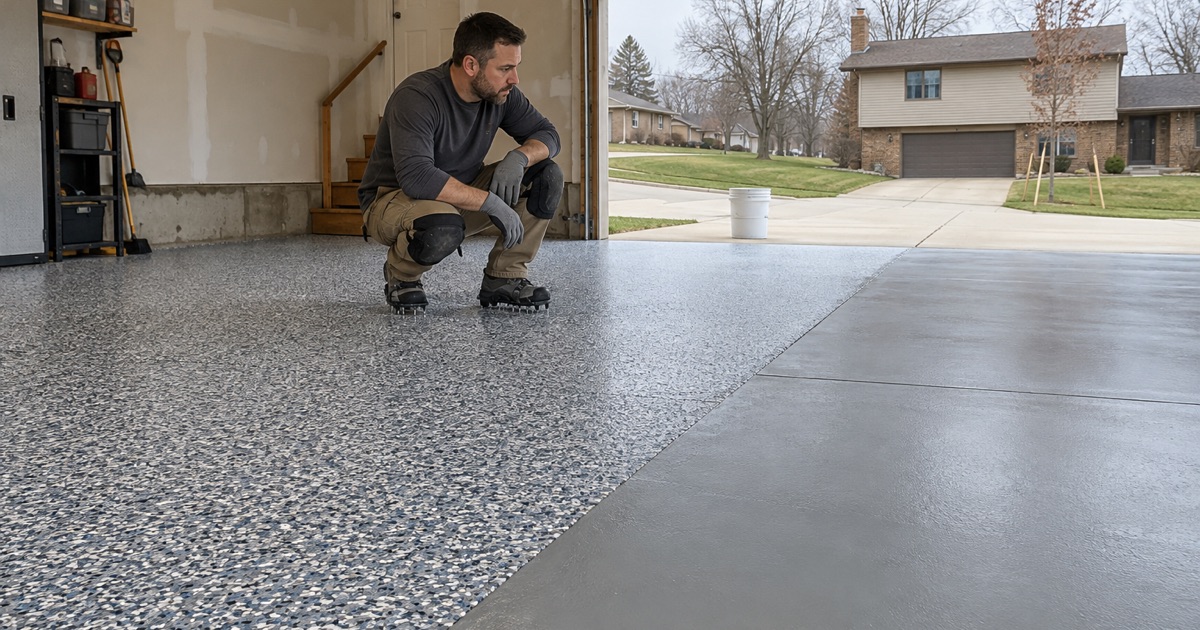
Color Blends That Hide Wear
Flake blends range from quiet grays and tans to high-contrast mixes with black, white, blue or red accents. The busier and more neutral the blend, the better it hides road grime, dust and tire marks between cleanings.
We bring physical sample boards to the estimate so you can see the chips on your own slab under your own lighting. A blend that looks warm in a showroom photo can read very differently under cool garage LEDs, and seeing it in place avoids that surprise.
Large, Medium and Small Chips
Chip size changes the look as much as color does. Larger chips read boldly from across a two-car garage, while smaller chips create a tight, almost stone-like pattern.
Smaller chips also leave a smoother surface under the topcoat, which some homeowners prefer in basements and laundry rooms where people walk in socks. Larger chips tend to give a little more texture underfoot, which can help in a garage that sees snowmelt.
Full Broadcast Versus Partial Broadcast
A full broadcast throws flakes until the base coat will hold no more, so no base color shows through. That gives the most uniform appearance, the best texture and a thicker overall build.
A partial or light broadcast lets the base color show between scattered chips. It suits some commercial and decorative uses, but in a garage we almost always recommend a full broadcast for durability and for hiding the concrete underneath.
Building the System Under the Flakes
Diamond Grinding and Repairs
Every flake floor starts with a diamond-ground slab. Grinding removes weak surface paste, sealers and old coatings and leaves a profile the base coat can grip, which an acid etch does not do reliably.
Cracks, spalls and pits are filled and ground flush before coating. The flakes hide minor surface variation, but a crack left open can still telegraph through the system and collect dirt along its line.
Moisture Testing and Primer Choice
Garage slabs often lack the vapor retarder a basement floor has, and basement slabs sit against damp soil. We test the concrete for moisture as part of the written scope before we price the job.
If vapor emission or relative humidity runs high, a moisture-mitigation primer goes under the base coat. The proposal states the reading that drove the choice, so you know why it is there.
Base Coat, Scrape and Topcoat
The base coat is usually a 100% solids epoxy or a polyaspartic, depending on the schedule and the space. After the broadcast cures, loose chips are scraped and vacuumed off, leaving an even, sharp-edged surface ready for the topcoat.
The topcoat is typically a polyaspartic or polyurea that resists ultraviolet ambering, hot tire pickup and chemicals. The proposal names each product, the number of coats and the finished thickness, so the finished floor can be checked against the quote.
Flake Floors in Iowa Garages
Road Salt and Freeze-Thaw
From November through March, vehicles carry brine and rock salt into the garage every day. On bare concrete, that salty water soaks in and breaks down the surface through repeated freezing and thawing.
A full-broadcast flake floor keeps the salt on top, where it can be squeegeed out the door. We recommend rinsing the floor now and then over the winter so dried salt residue does not dull the topcoat.
Texture for Snowmelt
The chips give some texture on their own, but a garage that takes heavy snowmelt or has a slope to the door may need more grip. We can add fine aggregate to the topcoat in walking paths and parking lanes while keeping work areas smoother.
Texture is specified by the broadcast and topcoat, not promised as a slogan, so we decide it area by area with you.
Cold Weather Scheduling
Coatings cure slowly on a cold slab, and condensation near the dew point causes poor bonding between the base, flakes and topcoat. We measure slab temperature and dew point before each coat goes down.
Heated garages can be done year round. An unheated garage in the middle of a Linn County winter is better scheduled for spring than rushed into a floor that never fully cures.
Beyond the Garage
Basements, Laundry Rooms and Workshops
In basements, a flake floor brightens the space and cleans easily after laundry spills or workshop projects. The moisture test matters even more here, and we always check the sump pit and floor drain before coating.
We finish neatly around pits and drains so they stay accessible, and we never sell a flake floor as a substitute for basement waterproofing.
Commercial Flake Floors
Locker rooms, restrooms, break rooms, service bays and retail back rooms use flake floors for their durability and easy cleaning. Integral coved bases at the walls make cleaning more thorough in wet areas.
Commercial flake floors are phased around business hours, with dust captured at the grinder and fast-curing products used where downtime is costly.
- 20+ Years on Concrete
- Moisture Tested Before Pricing
- Free Written Estimates